-
Jack Janasiewicz, senior vice president, portfolio manager and portfolio strategist at Natixis Investment Managers Solutions, discusses inflation and why there is disagreement on whether it will become an issue this year. He talks about how stimulus money and the employment situation factor in. Gary Siegel hosts. (Taped March 9 / 30 minutes).
 April 6
-
Both personal income and expenditures dropped in February, while personal consumption expenditures also came in weaker than expected, meaning inflation remains in check for now.
March 26
-
The primary led the secondary to lower yields as UST 10-year fell to lows last seen a week ago. Regional service sector surveys released Tuesday showed improvement, which feeds into the belief that inflation will rise in the near term.
March 23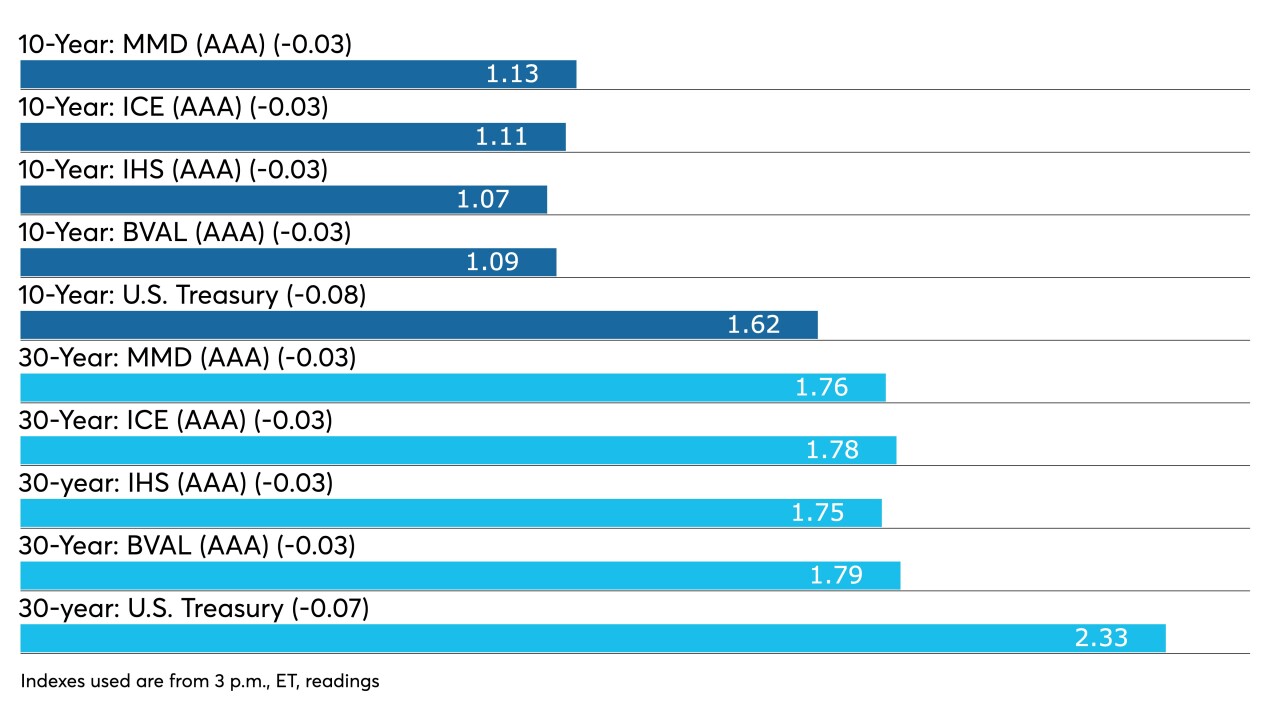
-
Exactly one year after record billions were pulled from municipal bond mutual funds and the market was in free fall, municipals followed U.S. Treasuries this week as the markets continued to dismiss the Fed's outlook on inflation and rates.
March 19
-
Yields jumped as much as 10 basis points as new deals saw some concessions as munis played catch up to the run-up in U.S. Treasury rates after the 10-year hit 1.75% mid-session. Refinitiv Lipper reports nearly $1.3 billion of inflows.
March 18
-
Municipals largely ignored the moves to higher yields in U.S. Treasuries as participants await the largest new-issue calendar of 2021 and big-name deals out of New York and Illinois.
March 12
-
The Investment Company Institute reported outflows from municipal bond mutual funds but inflows into exchange-traded funds. The February consumer price index came in as expected, while the core was below expectations, and analysts expect bigger rises ahead.
March 10
-
Munis were stronger across the curve as secondary trading was constructive and bellwether credits moved yields lower.
March 9
-
Despite the recent outflows and volatility of the Treasury market, municipal bonds have and should continue to outperform as stimulus from Washington provides some respite.
March 8
-
She has repeatedly rejected concerns that Biden’s stimulus is excessive given the economy’s signs of recovery, and that run-away inflation could damage the economy.
March 8
-
The Beige Book suggests the economy is recovering, with optimism for 6-12 months ahead, while economists don't envision inflation rising enough for the Fed to take action any time soon.
March 3
-
The Federal Reserve is nowhere near to pulling back on its support for the pandemic-damaged U.S. economy, Chairman Jerome Powell signaled at his testimony before Congress on Tuesday.
February 23
-
Federal Reserve Bank of Boston President Eric Rosengren said he doesn’t expect to see sustained 2% inflation for the next two years so long as U.S. unemployment remains high.
February 17
-
The municipal secondary gave way to higher-yields and triple-A benchmarks rose two to five basis points. U.S. Treasuries pared back Tuesday's losses, even on the heels of better economic data.
February 17
-
With the U.S. Treasury sell off, municipal to UST ratios fell below 55% in 10-years.
February 16
-
While most observers expect inflation to grow as the economy heals, the latest CPI numbers suggest that it hasn't yet arrived.
February 10
-
Even if there was some hesitation in the past few sessions to accept lower municipal yields given rich valuations, municipals continue grinding lower. One- and two-year AAA yields hit record lows of 0.06% and 0.08%, respectively.
February 9
-
Why has inflation remained low and how will the economic recovery impact it? Several experts offer their views as to whether inflation is or will be a problem.
February 8
-
No rate hikes in sight as employment continues to struggle and inflation should rise this year, but not enough to force the Fed to raise rates.
February 4
-
Robin Marshall, director of fixed income research at FTSE Russell, talks about what investors should be paying attention to during the coming year. He looks at inflation prospects, possible Central Bank actions and the continuing effects of the COVID-19 pandemic. Chip Barnett hosts. (15 minutes)
 January 21


