-
The Federal Reserve governor said an upcoming change to the personal consumption expenditures index could show ongoing improvement in prices, building the case for leaving interest rates unchanged.
 September 3
-
Federal Reserve Bank of New York President John Williams said Wednesday that inflation expectations remain well anchored, suggesting a "wait-and-see" approach for monetary policy.
 September 2
-
Near-term expectations for price growth fell in the latest consumer sentiment survey from the Federal Reserve Bank of New York, but remains above the central bank's target across all time horizons.
August 7
-
Many factors impact the performance of munis, and, this year, everything seems to be working for the positive.
June 12
-
Federal Reserve Vice Chair for Supervision Michelle Bowman said Friday that she believes price growth is still heading toward the central bank's 2% target when factoring out one-time shocks such as tariffs and elevated oil prices.
May 29
-
The Federal Reserve Board governor is the latest Fed official to embrace the prospect of tighter monetary policy in response to rapidly rising prices that have taken hold in recent years.
May 27
-
Federal Reserve Gov. Christopher Waller said Friday that the length of time the Strait of Hormuz remains blocked will be a key factor in the longer-term inflation outlook — and, by extension, the Federal Reserve's monetary policy path.
April 17
-
Federal Reserve Gov. Stephen Miran Thursday said that the Iran war and tariffs will not have long-term impacts on inflation, but did say he is reconsidering his rate cut outlook for the year.
April 16
-
With the "fragile" ceasefire in the United States-Iran conflict underway, the risk of higher rates beyond those from March has largely been removed, said BofA strategists.
 April 10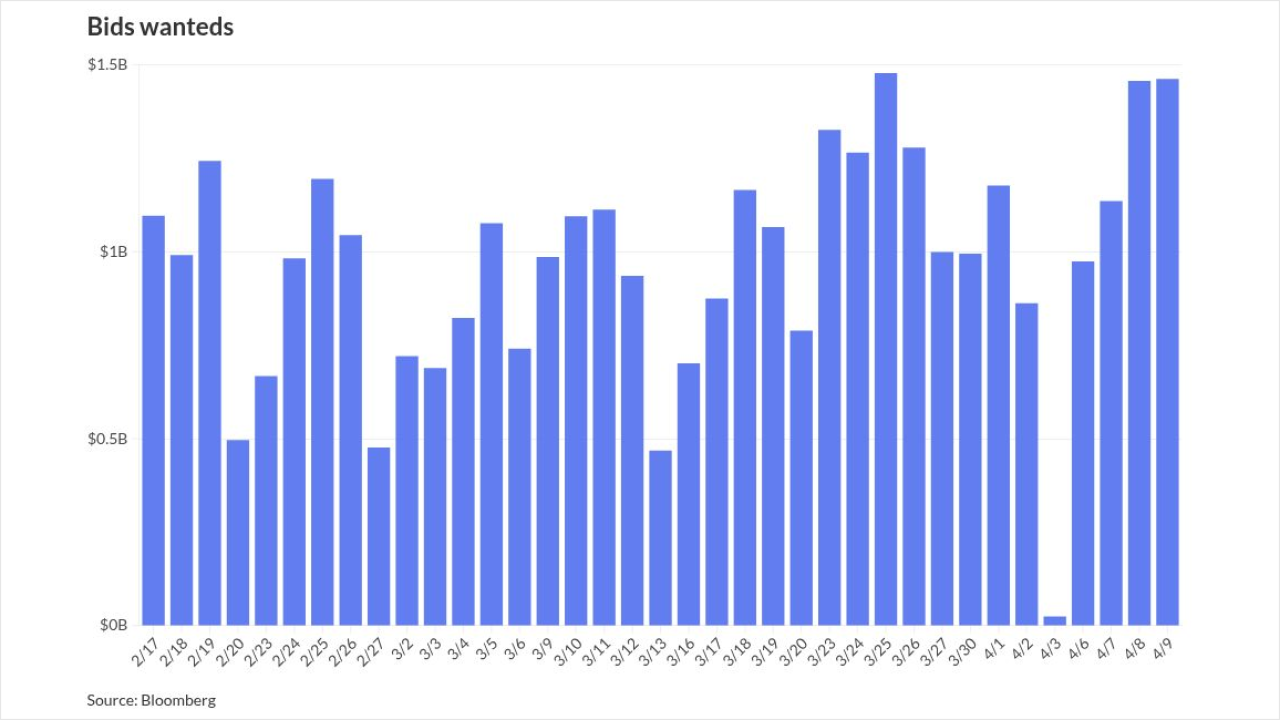
-
Financial markets, including the muni market, priced in too much of a "sure thing, done deal" Wednesday morning, said Kyle Gerberding, director of trading, a portfolio manager and partner at Asset Preservation Advisors.
April 8
-
Wednesday's market rally is tied to President Donald Trump's announcement of the temporary ceasefire, which came about Tuesday night, an hour and a half before the president's 8 p.m. deadline, market participants said.
April 8
-
"You would think global instability leads to flight for quality, but you also have the inflationary pressures that come with higher oil prices. I would say the inflationary pressures have been winning, and that's why you're seeing Treasury and muni rates move higher," said Keith Richard, head of public finance at Siebert Williams Shank.
March 24
-
The weakness in fixed-income markets comes after stocks and bonds saw strength Monday following President Donald Trump's announcement of a five-day pause on strikes on Iranian power plants amid talks between the two countries.
March 24
-
"Unsurprisingly, the market is taking these numbers in stride, with the bond market only slightly higher after a large rally over the last couple of days due to the equity market sell-off," said John Kerschner, global head of securitized products and portfolio manager at Janus Henderson Investors.
February 13
-
"The bond market breathed a sigh of relief this morning as the CPI inflation numbers came in a tad weaker than expected," said John Kerschner, global head of securitised products and portfolio manager at Janus Henderson Investors.
January 13
-
Muni yields were bumped a basis point, while UST yields fell two to four basis points.
December 18
-
"Investors were not disappointed," said John Kerschner, global head of securitized products and portfolio manager at Janus Henderson. "Inflation came in softer than expected, leading to a tepid bond market rally" and ensuring a rate cut at the upcoming Federal Open Market Committee meeting.
October 24
-
Federal Reserve Vice Chair Philip Jefferson said Friday that the economic outlook is uncertain and that he was adopting a cautious approach to gauging whether slowing growth and a softening labor market outweigh inflation pressures from tariffs.
 October 3
-
Investors added $2.183 billion to municipal bond mutual funds in the week ended Wednesday, following $623.3 million of inflows the prior week, according to LSEG Lipper data.
September 11
-
Muni yields were bumped two to 12 basis points, depending on the scale, with the largest gains out long, and UST yields fell six to nine basis points, pushing the two-year UST to its lowest levels in over two years.
September 5


