

Jessica Lerner is a senior reporter and buy-side specialist for Bond Buyer where she writes the daily market column, the monthly volume story and longer trend stories. Prior to this, she worked as a beat reporter at two Connecticut newspapers. She earned her master's in business and economics reporting from the Craig Newmark Graduate School of Journalism and her bachelor's in journalism and statistics from the University of Connecticut.
-

High-yield and taxable munis continue to outperform, supply grows but concentrates in larger deals led by $3 billion of state personal income tax revenue bonds from the Dormitory Authority of the State of New York next week.
March 8 -

Several investors in a challenge to a University of California Regents Build America Bonds redemption "may give issuers additional reason for pause when vetting similar refundings," J.P. Morgan strategists said.
March 7 -

It was a good day for munis with larger deals clearing the primary and secondary trading showing a more constructive tone with triple-A yields falling a few basis points amid a stronger session for all markets.
March 6 -

Harvard and Princeton coming to market is a "huge sign of confidence," said Clare Pickering, a Barclays strategist.
March 6 -

Large deals were repriced to lower yields while the secondary market was lightly traded, leading to little changed triple-A yield curves and underperformance to Treasury market gains. Despite a growing calendar, the supply demand imbalance remains with much cash on the sidelines.
March 5 -

The muni market "exhibited similar themes from the past few weeks as extremely rich valuations and the upcoming unfavorable supply/demand picture have led to a measured buyer base," said Birch Creek Capital strategists in a report.
March 4 -

The bank has also hired some analysts to its infrastructure group over the past several weeks as it plans to beef up its muni team.
March 4 -
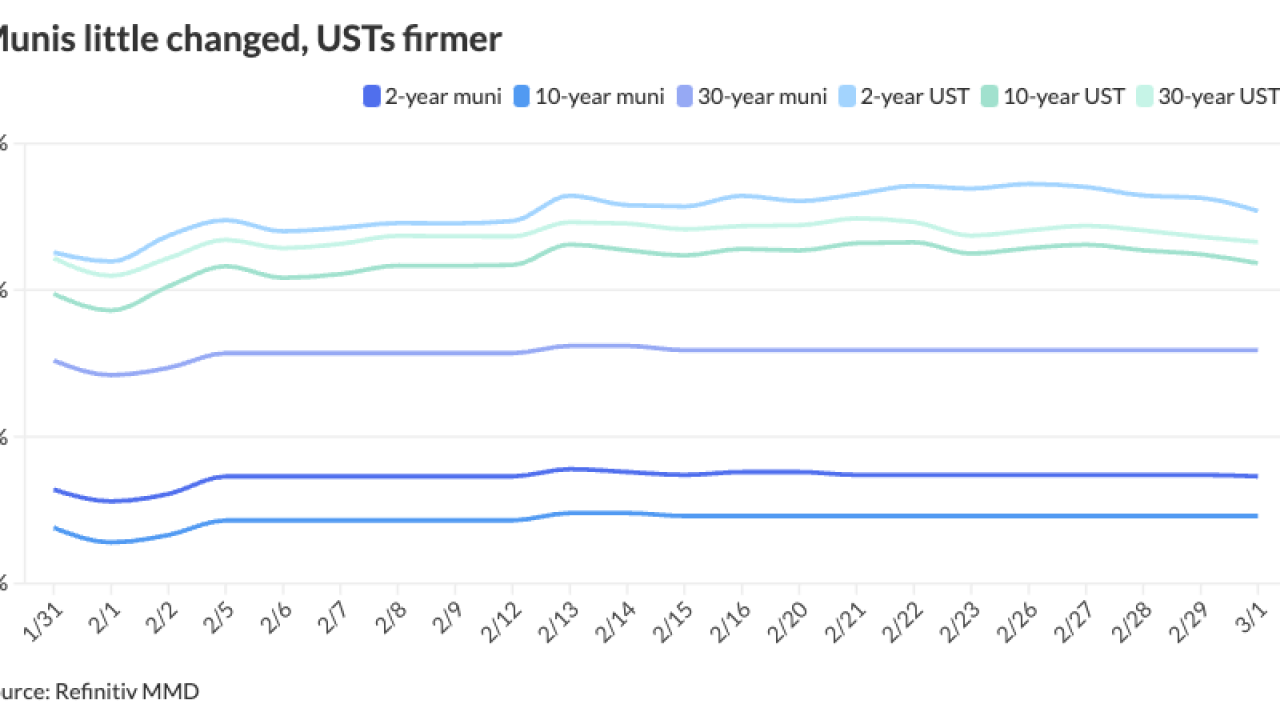
The negotiated calendar is led by the Regents of the University of California with nearly $1 billion of general revenue bonds.
March 1 -

High rates and high inflation, coupled with rich reserves, pushed off or delayed issuers coming to market in 2023, noted James Pruskowski, chief investment officer at 16Rock Asset Management.
March 1 -

Issuance is already slated to be healthy next week, with some large deals on the calendar.
February 28 -

Three of the hires are group heads in public sector and structured finance businesses at the firm.
February 28 -

Munis should remain well bid until issuance picks up "dramatically," said Nuveen's Anders S. Persson and Daniel J. Close.
February 27 -
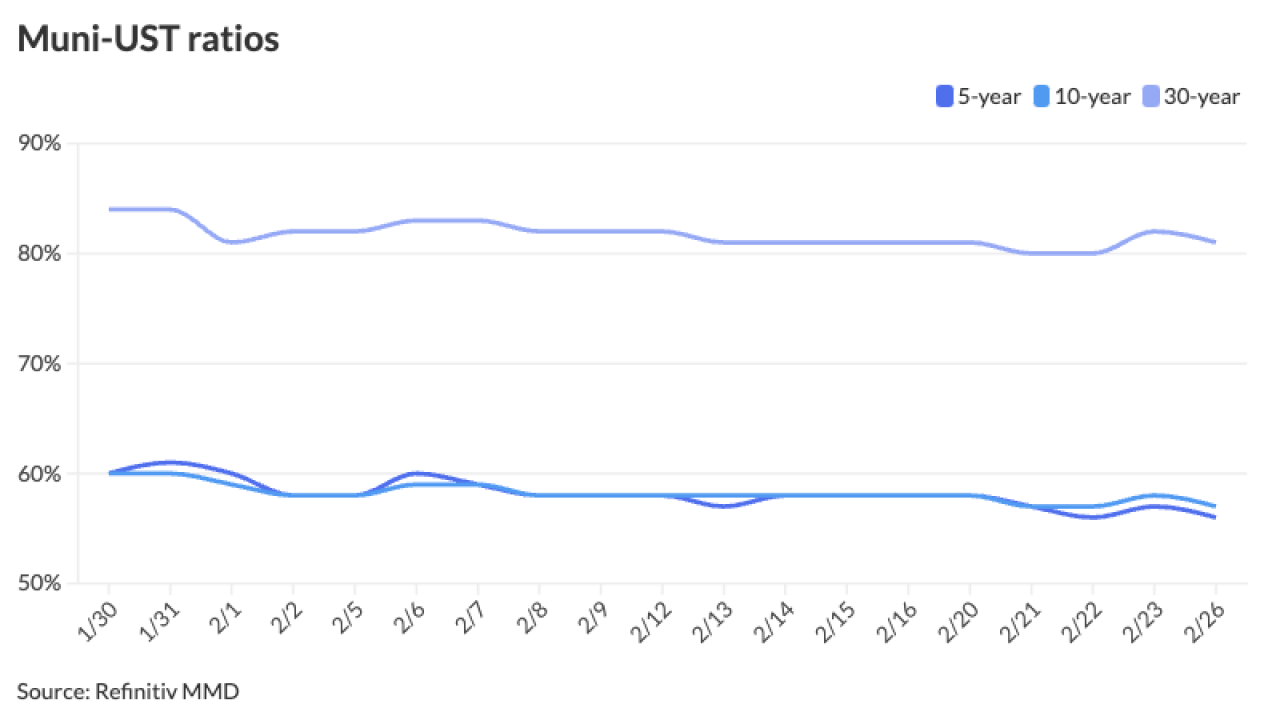
CreditSights said states with the largest payments are Texas at $2 billion, Pennsylvania at $1.5 billion, South Carolina at $1.3 billion and California at $1.2 billion
February 26 -
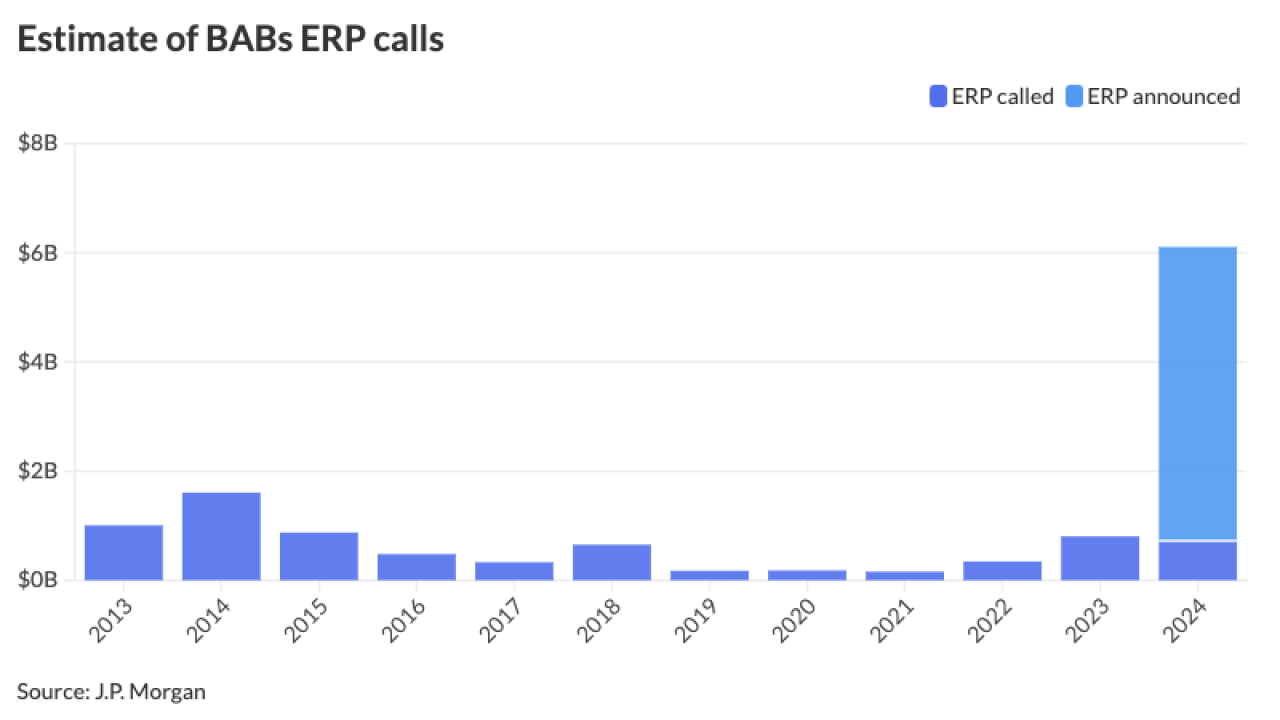
With a recent court ruling and higher interest rates in their favor, more issuers are likely call back their outstanding BABs using the extraordinary redemption provision.
February 26 -

Supply is expected to increase in the coming weeks, and there may be more rate-direction volatility, said Kim Olsan, senior vice president of municipal bond trading at FHN Financial.
February 22 -

"We built a modern marketplace that provides an equity-like trading experience back to the brokerages," said Jonathan Birnbaum, OpenYield's founder and CEO.
February 22 -

Policymakers appear to be concerned about the possibility of cutting interest rates too soon, according to minutes of the Federal Open Market Committee's Jan. 30-31 meeting, released Wednesday.
February 21 -

"With the new economic data signaling a delay of the Fed starting rate cuts to further into the year, we should continue to see yields rise until we get near to the Fed's target of a 2% 'neutral' rate for inflation," said Jason Wong, vice president of municipals at AmeriVet Securities.
February 20 -

All municipal bond insurers wrapped $35.381 billion in 2023, a 5.8% increase from the $33.428 billion insured in 2022, according to LSEG data.
February 20 -

Bond volume fell slightly, as volatility, higher interest rates, falling pandemic aid and slower economic growth kept issuers on the sidelines.
February 20


