

Jessica Lerner is a senior reporter and buy-side specialist for Bond Buyer where she writes the daily market column, the monthly volume story and longer trend stories. Prior to this, she worked as a beat reporter at two Connecticut newspapers. She earned her master's in business and economics reporting from the Craig Newmark Graduate School of Journalism and her bachelor's in journalism and statistics from the University of Connecticut.
-

The muni credit market has experienced headwinds this year, including "potential federal funding cuts, the impact of tariffs and sector-specific pressures," said Goldman Sachs strategists
December 29 -

The muni bond market stands at an "inflection point," said Nuveen strategists in a 2026 market outlook.
December 26 -

"A stagnant yield curve is resulting from supply having wound down and munis drawing steadiness from a likewise calm UST market," said Kim Olsan, senior fixed income portfolio manager at NewSquare Capital.
December 24 -

It was a "confusing, volatile year, and the states face growing threats in 2026 and thereafter," said Matt Fabian, president of Municipal Market Analytics.
December 23 -

Unless there is a massive selloff in the next two weeks, there will not be a major spike in market participants using tax-loss harvesting through year-end, said Ben Barber, director of municipal bonds at Franklin Templeton.
December 23 -

Following the September/October rally, munis have been relatively steady in November and December, with direction and magnitude of rate change in the UST market driving underperformance or outperformance, said J.P. Morgan strategists led by Peter DeGroot.
December 22 -

Supply for the final two weeks of the year will be virtually nonexistent, with only one deal, $24.46 million of taxable multi-family/project bonds from the Colorado Housing and Finance Authority, on the calendar for next week.
December 19 -

Muni yields were bumped a basis point, while UST yields fell two to four basis points.
December 18 -

"Once this week is done, that's it for the year. The following week is Christmas, and then after that, the new year," said Jeff Timlin, a partner at Sage Advisory.
December 17 -

Inflation reports may drive markets in 2026 since the labor market is "sending mixed messages," said Kevin O'Neil, associate portfolio manager and senior research analyst at Brandywine Global.
December 16 -

Next year, the "muni market could see stable to improving returns depending on yield curve positioning, with better performance possible at the long end of the curve," said Jonathan Rocafort, managing director and head of fixed income solutions at Parametric.
December 15 -
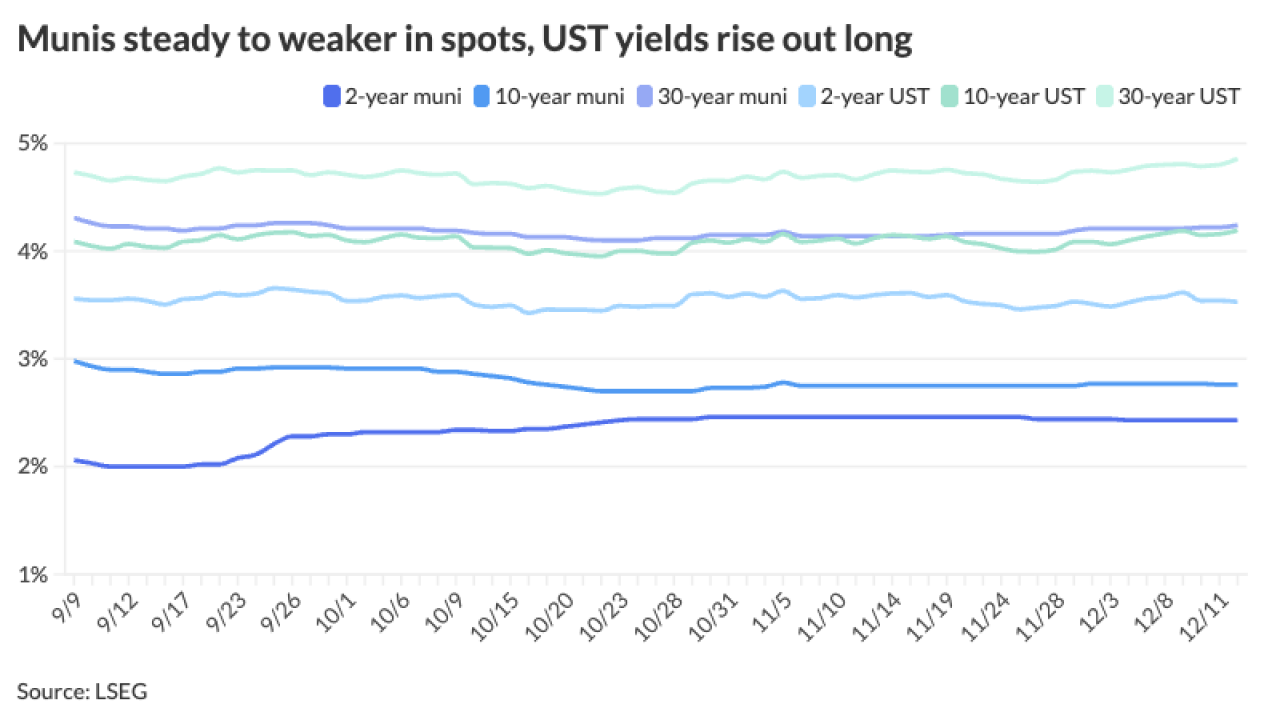
The New York City Transitional Finance Authority leads the new-issue calendar with $2 billion of future tax-secured subordinate refunding bonds.
December 12 -

Both Janney and Huntington are among the top 30 underwriters in the muni market and are neck in neck.
December 12 -

"With its third straight rate cut, the Fed is sending a clear message: it's no longer just watching inflation — it's managing risk," said Gina Bolvin, president of Bolvin Wealth Management Group.
December 11 -
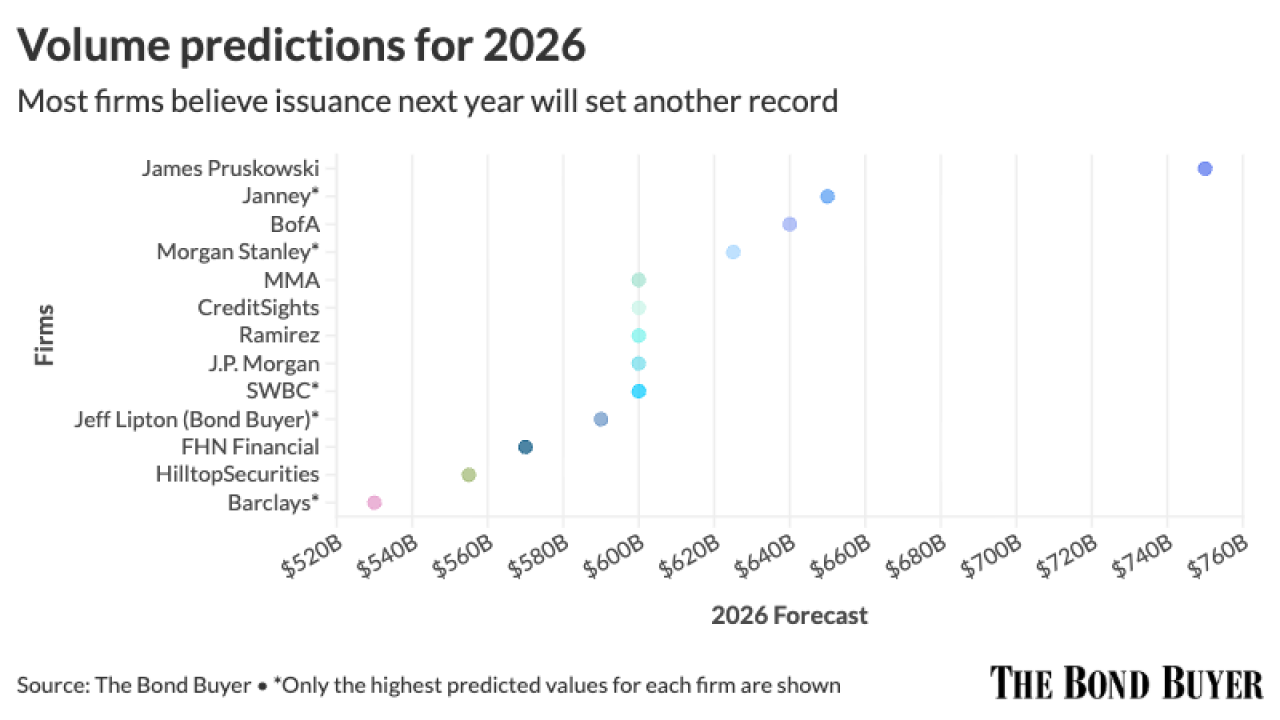
Municipal bond supply projections for next year range from a high of $750-plus billion to a low of $520 billion, with most firms expecting issuance to hover around $600 billion, easily surpassing 2025's record.
December 10 -

While muni returns moved lower last week, year-to-date returns still hover around 4%, said Jason Wong, vice president of municipals at AmeriVet Securities.
December 9 -

Concerns about Brightline have dragged down performance in the high yield sector this year.
December 9 -

Issuers mostly avoided pricing deals in the previous weeks the Fed met this year, but that's not the case this week, said Pat Luby, head of municipal strategy at CreditSights, and Wilson Lees, an analyst at the firm.
December 8 -

The tax-exempt muni market has performed "exceptionally well" so far this week, outperforming USTs, said J.P. Morgan strategists led by Peter DeGroot.
December 5 -

Robust issuance this year has contributed to muni underperformance relative to other asset classes, but it also has "improved after-tax relative value for investors in higher tax brackets," said Sam Weitzman of Western Asset.
December 4


Load More